Stand at an Australian butcher counter long enough and someone will tell you that boerewors is just a beef sausage with a bit of extra spice in it. It is not, and the boerewors vs sausage question is not a matter of opinion or homesick pride. Both countries have written down what they will allow a thing to be called, and the two rulebooks ask for very different amounts of meat.
Quick translation before we go on. Boerewors is Afrikaans for farmer’s sausage, and wors is the short form, the way an Australian says snags. A braai is a fire of wood or coals with food cooked over it, which we have already argued out properly here. What follows is what genuinely separates the two products, and what that means when you are standing at the counter with your wallet out.
Table of Contents
- The short answer
- Boerewors vs sausage: what each country’s law actually demands
- The preservative difference nobody mentions
- The braaiwors trap, which catches South Africans too
- Coriander does the work, and the law never says so
- The coil is not decoration
- Boerewors vs sausage at a glance
- What to ask an Australian butcher
- Can you turn Australian snags into wors?
- So which one is better?
The short answer
South African law says boerewors must be at least 90 percent meat, with fat capped at 30 percent, packed into an edible casing.
Australian law says a sausage must be at least half fat-free meat flesh, and it may legally carry up to 500 milligrams per kilogram of sulphur dioxide preservative.
So a perfectly legal Australian sausage can be half meat and still be sold as a sausage. A legal boerewors cannot. That gap is the whole story, and everything below is the detail underneath it.
Boerewors vs sausage: what each country’s law actually demands
South Africa’s rules sit in Regulation R2410 of 26 August 2022, made under the Agricultural Product Standards Act of 1990. Raw boerewors is defined there as any sausage sold under a name containing the word boerewors, and to use that name the product must:
- be made from the meat of cattle, sheep, pigs or goats, or a mixture of them
- be contained in an edible casing
- have a minimum total meat content of 90 percent
- have a fat content of no more than 30 percent as analysed
- contain no offal at all, except where the offal is the casing itself
- contain no mechanically recovered meat and no colourants
- contain nothing else added beyond cereal or starch, vinegar, spices, herbs, salt, food additives and water
Australia’s rules sit in Standard 2.2.1 of the Australia New Zealand Food Standards Code. A sausage there is defined as minced or comminuted meat, “whether or not mixed with other foods”, encased or formed into discrete units. Anything sold as a sausage must contain no less than 500 grams per kilogram of fat-free meat flesh, with fat no more than 500 grams per kilogram of that fat-free meat flesh content.
Read that middle phrase again, because it is doing a lot of quiet work. Whether or not mixed with other foods. Australian sausages are allowed a generous serving of rusk, breadcrumb, flour and water, and the standard is satisfied as long as half the weight is fat-free meat flesh. That is not a scandal. It is a different product with a different brief, and it is why a snag has that soft, bready bite that boerewors never has.
The preservative difference nobody mentions
There is a second gap, and it explains a taste you may have noticed without being able to name it. The Western Australian Department of Health sets it out plainly: a maximum of 500 milligrams per kilogram of sulphur dioxide and sodium and potassium sulphites is permitted in sausages and sausage meat containing raw unprocessed meat, and no other type of meat product may contain any at all. Sausages are the one place in the Australian meat cabinet where that preservative is allowed.
It keeps the mince looking cheerfully red for longer, which matters when a tray sits under lights all day. Some people taste it as a faint sharpness at the back of the mouth. Interestingly, the same guidance notes that a patty advertised as 100 percent beef is not permitted to contain sulphur dioxide at all.
Be fair about this, though. The South African regulation also permits food additives in boerewors, so this is not a story about one pure product and one chemical one. It is a story about what each standard makes routine.
The braaiwors trap, which catches South Africans too
Here is the part that surprises people who grew up eating the stuff. In South African law, braaiwors is not a friendly nickname for boerewors. It is a separate legal class with far weaker requirements: a minimum total meat content of 40 percent, and it may contain mechanically recovered meat, edible offal and colourants, none of which boerewors is allowed.
So if you are buying at a South African shop here in Australia and the label says braaiwors or sizzler rather than boerewors, that is not the shop being casual with words. It is a different product, priced accordingly. Our state-by-state directory of South African shops will get you to the counter; the label is your job.
Coriander does the work, and the law never says so
Now for the honest bit. Nowhere in that South African regulation does it name a single spice. It permits spices, herbs, vinegar and salt, and then stops. The coriander-forward flavour that makes wors taste like wors is tradition, not legislation, held in place by a few million people who would notice immediately if you changed it.
Toasted coriander seed is the backbone, usually with black pepper and a warm spice or two behind it, and vinegar somewhere in the mix. If what you are eating leans on fennel, sage or garlic, you are eating a very nice sausage that is not boerewors. Australian beef snags mostly do not chase a spice profile at all; their flavour comes from fat, rusk and salt, which is exactly what you want inside a bread roll with fried onions.
The coil is not decoration
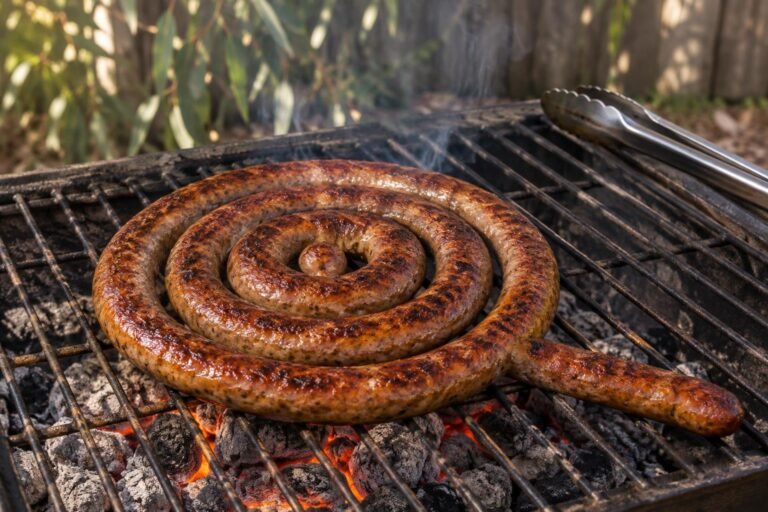
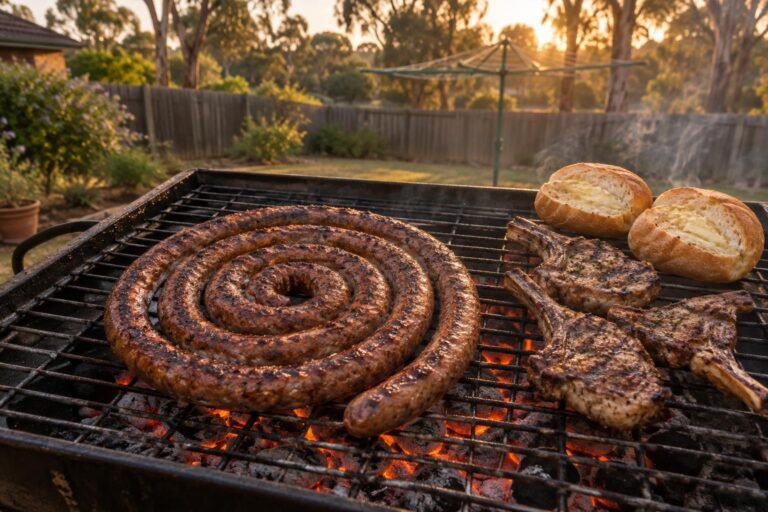
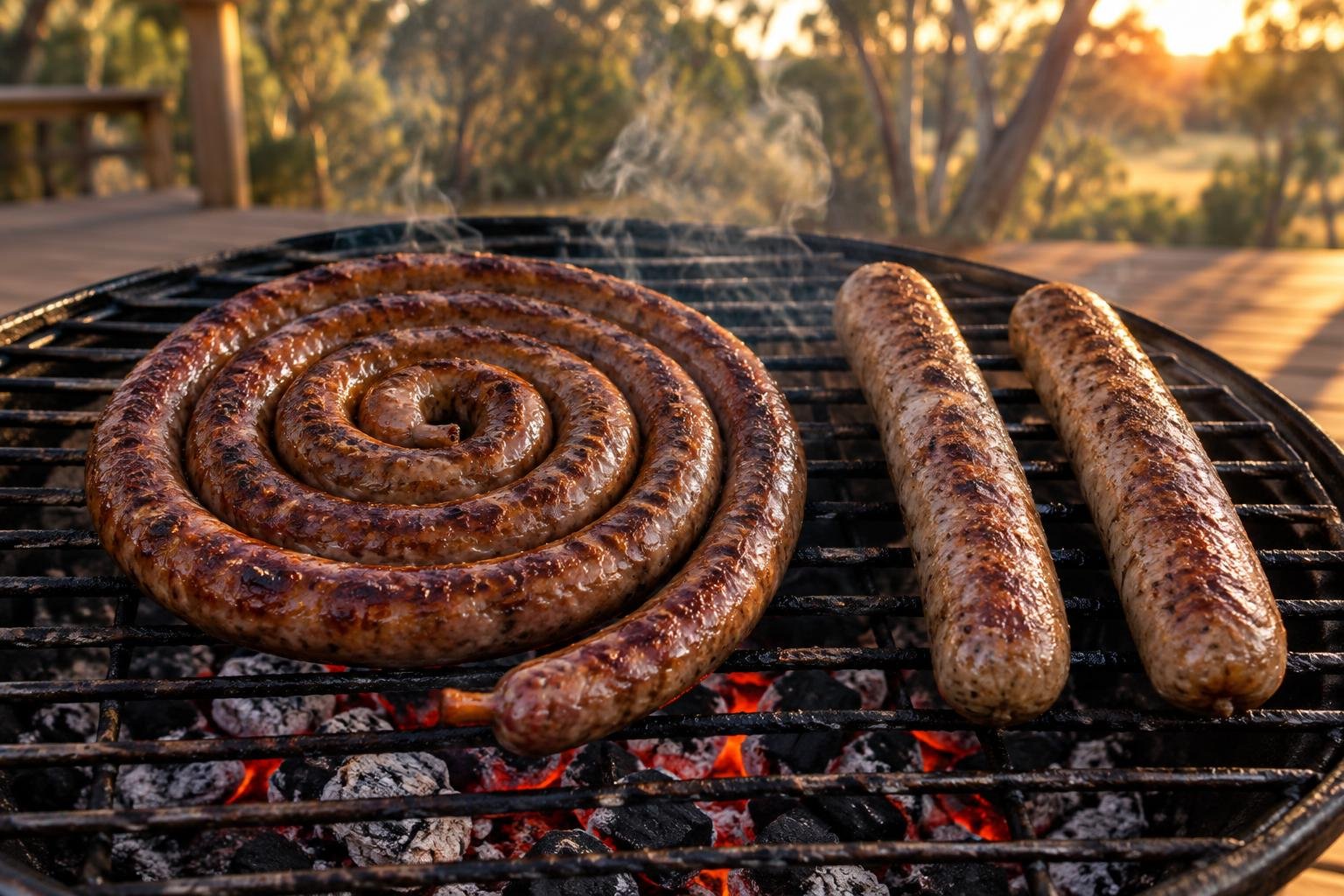
Boerewors comes as one continuous length wound into a flat spiral, and that shape earns its place on the fire. Fewer cut ends means less fat escaping into the coals and fewer flare-ups licking up at your dinner. One big coil turns as a single piece if you slide two long forks or a flat lifter under it, so you are not fussing over eight separate snags at eight different stages of done. And a thick, unlinked length simply takes longer to dry out.
None of that is in the regulation either. It is just what generations of people worked out around a fire.
Boerewors vs sausage at a glance
| Boerewors, South African rules | Sausage, Australian rules | |
|---|---|---|
| Minimum meat | 90 percent total meat content | 500 g/kg fat-free meat flesh, so half by weight |
| Fat | No more than 30 percent as analysed | No more than half the fat-free meat flesh weight |
| Casing | Edible casing required | Not specified in the sausage standard |
| Offal | Not permitted, except as the casing | Not banned, but must be declared on the label |
| Mechanically recovered meat | Not permitted | Not banned by the sausage standard |
| Sulphite preservative | Food additives permitted generally | Up to 500 mg/kg specifically permitted |
What to ask an Australian butcher
Most butchers here are genuinely happy to help; they simply do not know what you are picturing. So be specific.
Ask whether it is made to a boerewors recipe or whether it is a South African style beef sausage, which is a polite way of asking whether rusk has been invited. Ask what the meat percentage is, because a good butcher knows. Ask for a natural casing. And ask for it in one continuous coil rather than linked, which is the request that most often gets you a slightly delighted response, because nobody asks for that.
If you would rather not have the conversation at all, our guide to where to buy boerewors in Australia lists the shops and butchers who already make it properly, state by state.
Can you turn Australian snags into wors?
No, and it is worth saying so cleanly rather than pretending. You cannot take the rusk back out of a sausage, and you cannot add 40 percentage points of meat to something already in a casing. Rolling snags into a spiral gets you a spiral of snags.
What you can do is buy coarse-minced beef with a decent fat ratio and make your own, or find a butcher willing to run a batch to a recipe you bring in. Both work. Neither is a shortcut.
So which one is better?
Wrong question, and I say that as someone firmly on one side of it. An Australian snag on white bread with onions and tomato sauce, eaten standing up outside a hardware store, is a genuinely great piece of food, and it would be ruined by coriander. Boerewors is built for a long slow turn over coals and a place next to pap or a braaibroodjie, which is a toasted sandwich cooked on the grid.
They are two different answers to the same shape. The boerewors vs sausage difference is not that one is real meat and the other is not; it is that one country wrote 90 percent into law and the other wrote 50, and the products grew into the space each rulebook left them.
Now go and ask your butcher for a coil.