Every South African who has ordered a steak in Australia has had the same small, sad moment. The waiter lists the sauces. Pepper, mushroom, garlic butter, maybe a red wine jus. Nobody offers monkey gland. Hardly anyone here has heard of it, and the name does not help your case when you try to explain.
So you make it at home, and that is where this monkey gland sauce recipe comes in. The good news is that the sauce was always a cupboard job, built from bottles rather than from anything you have to hunt for. The only ingredient that gives expats trouble is the chutney, and there is a fix for that below that does not involve a two-hour drive to a South African shop.
First, the name.
Table of Contents
No monkeys were harmed
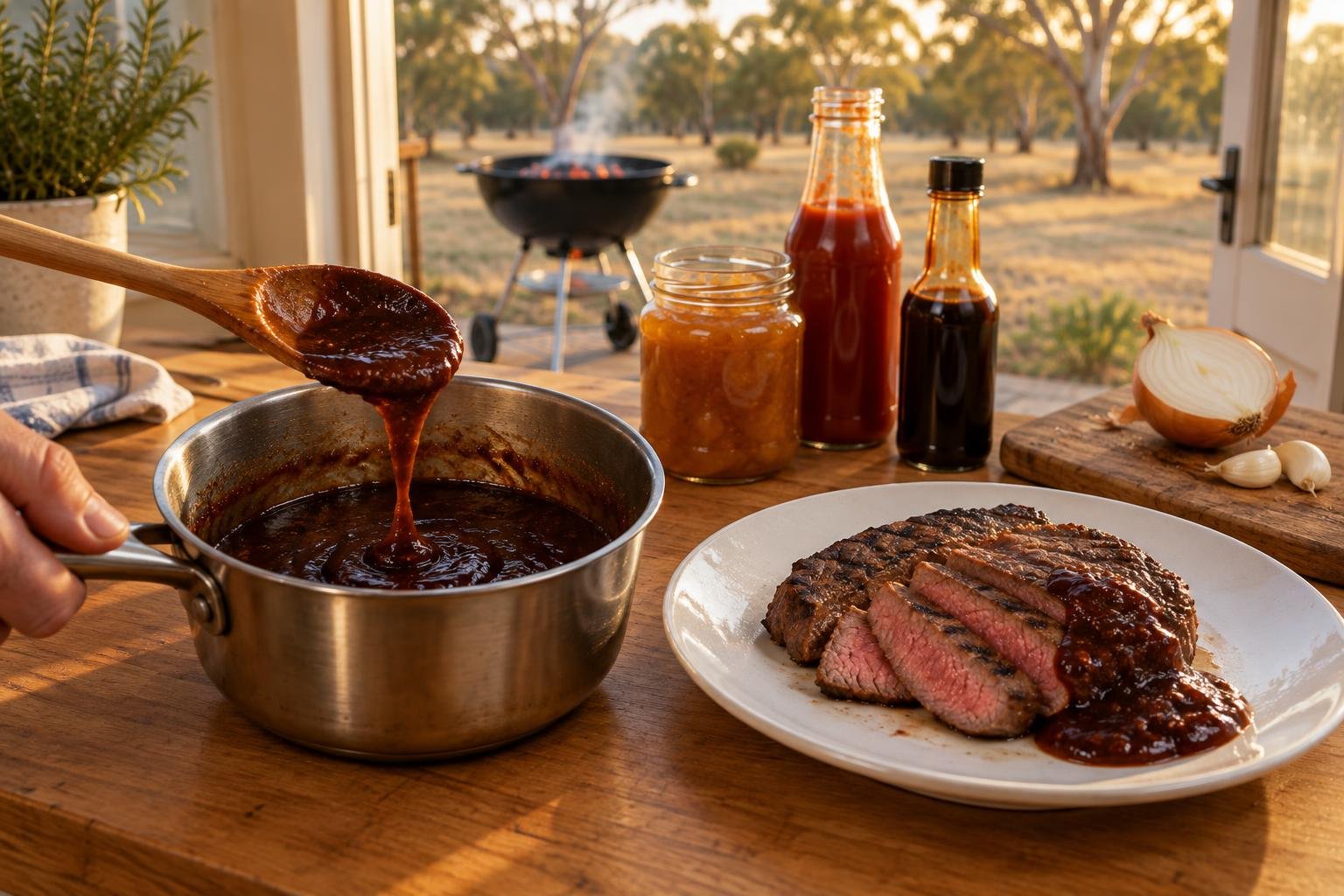
Monkey gland sauce is a thick, dark, sweet and tangy sauce served over steak and burgers in South Africa, and it contains no gland of any animal. It is tomato sauce and fruit chutney cooked down with onion, garlic, vinegar and Worcestershire sauce until it turns glossy and sticky. Think of it as a barbecue sauce that grew up in Johannesburg instead of Kansas City.
The name is the fun part. The most repeated story is that French chefs at the old Carlton Hotel in Johannesburg, tired of diners drowning their careful cooking in chutney, tomato sauce and Worcestershire sauce, mixed all three together in a fit of spite and gave the result a name that mocked the fashionable 1920s quack science of the day, when a doctor named Serge Voronoff was famous for grafting monkey glands onto men in the hope of restoring their youth. Another version has a Savoy Hotel waiter carrying the dish from London to South Africa in the 1930s. Nobody can prove either story. What everyone agrees on is that it has been on South African menus since about the 1930s and on steakhouse menus ever since.
If you want to read the tidy version of the argument, the Wikipedia entry on monkey gland sauce lays out both theories and is honest that neither is settled. We are not going to pretend otherwise here.
What you are actually making
Three bottles do the heavy lifting, so it helps to know what each one is bringing.
Tomato sauce gives the body and most of the sweetness. This is the one ingredient where Australia does you a favour. Australians say tomato sauce, not ketchup, and the bottle in a Coles or Woolworths trolley is a close cousin of the All Gold bottle you grew up with: sweet, a touch vinegary, thick enough to cling. It is a nice bit of history that Rosella, one of the oldest names on the Australian shelf, first made tomato sauce in 1899 and was exporting to South Africa by the early 1930s, right around the time monkey gland sauce was being born. Whether any of it ended up in a Johannesburg saucepan is anyone’s guess, but it is pleasing to think so.
Fruit chutney gives the fruit, the tang and the mild heat. In South Africa that means Mrs Balls, and this is the hard part. More on it in a moment.
Worcestershire sauce gives the dark, savoury, slightly fishy depth that stops the sauce tasting like sweet tomato jam. Lea & Perrins is the original, made in Worcester since 1837 and now sold in over 130 countries, one of which is this one. Any Australian supermarket has it. Cheaper local Worcestershire sauces work too, but they run sweeter and thinner, so if you use one, ease back on the sugar.
Everything else is what a normal Australian kitchen already owns: an onion, garlic, vinegar, a little sugar, a spoon of mustard, oil and water.
The chutney problem, solved
Mrs Balls chutney is the flavour that makes monkey gland sauce taste like home rather than like an American barbecue sauce with ideas. It is a sweet, sharp, apricot and peach chutney with a low chilli warmth, and there is no Australian jar that is exactly the same.
Two ways through. The first is to check the supermarket, because Mrs H.S. Ball’s Original is stocked at both Coles and Woolworths these days, usually hiding in the international aisle rather than with the regular chutneys. If your local store has it, you are done. Our directory of South African shops in Australia lists the specialist grocers if it does not.
The second is a swap, and it works better in this sauce than almost anywhere else, because the chutney is being cooked down with strong company. Use an apricot and peach fruit chutney, Beerenberg being the easiest to find, and sharpen it with a teaspoon of brown vinegar and a pinch of cayenne. We tested the options properly in the Mrs Balls chutney substitute guide, and the short version is that stone fruit chutney plus vinegar plus a little chilli gets you close enough that nobody at the table will say a word. Mango chutney on its own is too sweet and too smooth; if it is all you have, add extra vinegar and chilli and expect a slightly softer result.
The monkey gland sauce recipe
This makes roughly two cups, which is enough for a braai (the South African wood or charcoal barbecue, and the social occasion built around it) of six with some left for the next day’s chips. It takes about three quarters of an hour, most of it unattended. The card below has the full list and the steps, and the print button gives you a clean one-page copy for the kitchen.
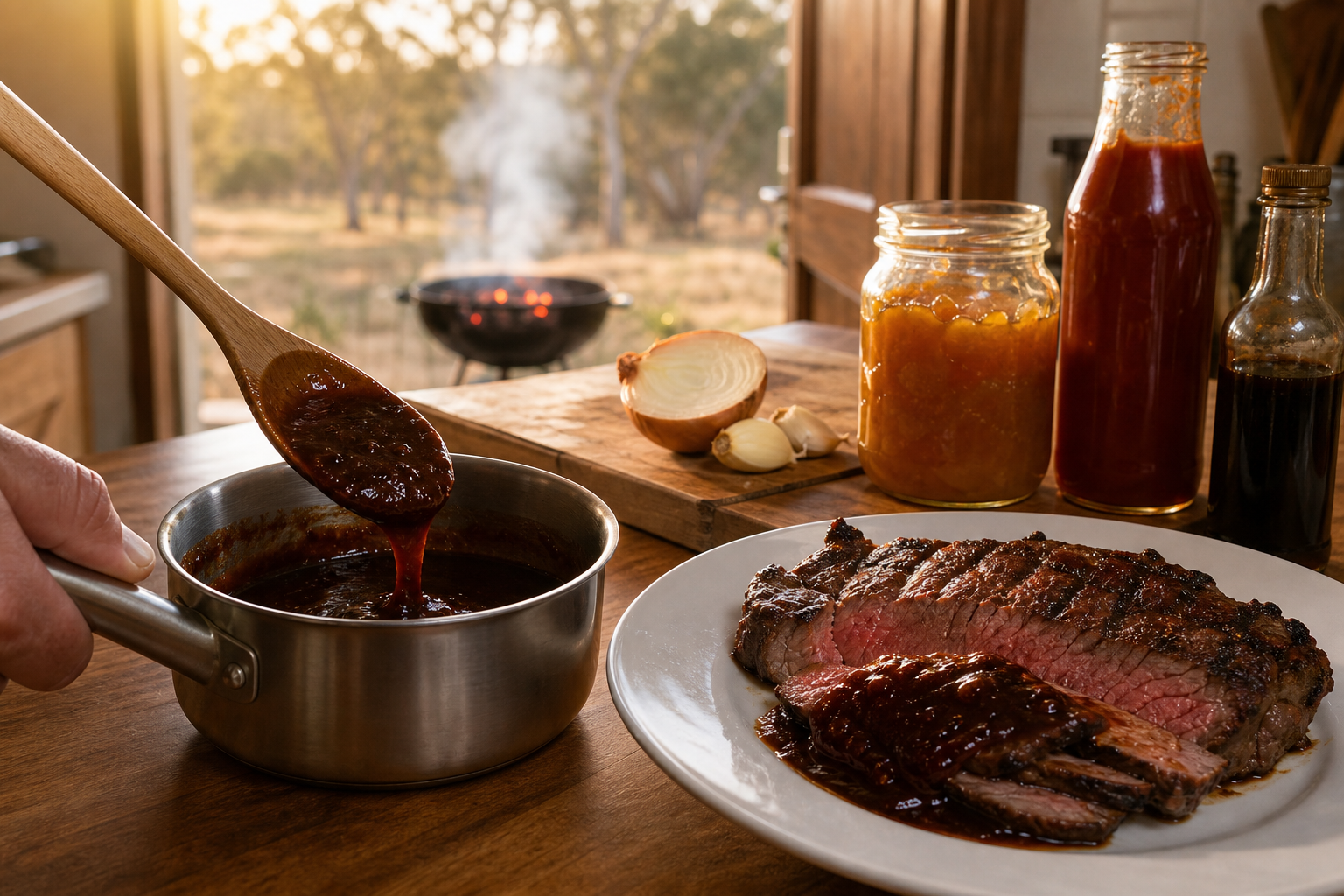
Monkey gland sauce
Ingredients
Method
- Warm the oil in a small saucepan over medium heat. Fry the onion gently for 8 to 10 minutes until soft, sweet and just starting to colour. Do not rush this step; half-raw onion is the most common way a batch goes wrong.
- Add the garlic and cook for one minute more.
- Add the tomato sauce, chutney, Worcestershire sauce, vinegar, sugar, mustard and water. Stir well and bring to a gentle simmer.
- Turn the heat down low and simmer uncovered for 20 to 25 minutes, stirring now and then, until the sauce has darkened, thickened and coats the back of a spoon. Add a splash of water if it thickens before the flavour comes together; turn the heat up a notch if it is still thin.
- Taste and adjust. Too sweet, add vinegar. Too sharp, add a pinch more sugar. Flat, add a splash more Worcestershire sauce. Season with salt and plenty of black pepper.
- Serve chunky, or blitz smooth with a stick blender for the steakhouse look. Keeps in a sealed jar in the fridge for about a week and tastes better on day two.
Notes
The sauce should taste sweet first, then tangy, then savoury at the back, with a faint warmth. Like most sauces built on vinegar and sugar, it is better on day two, so making it the day before a braai is a good habit.
What to put it on
Steak is the obvious answer, and a rump or a scotch fillet straight off the braai with a spoonful of warm monkey gland sauce over the top is the thing you were missing at that restaurant. Burgers are the second classic; South African takeaway chains have been putting monkey gland on burgers for decades.
But the sauce is more useful than that. Brush it over chicken thighs or pork ribs in the last ten minutes on the coals and it makes a proper sticky glaze; go earlier and the sugar burns. Spoon it into a boerewors roll (boerewors being the coiled, coriander-heavy beef sausage that a braai is built around) instead of tomato sauce and watch an Australian guest’s face change. Our state by state guide to buying boerewors in Australia covers where to find the wors.
It also does dipping duty for chips and onion rings, and stirred through a pan of fried mushrooms it makes a sauce for a steak you did not have time to braai. If you are still explaining to Australian friends why a braai is not just a barbecue, the braai vs bbq post handles that argument, and a jar of this on the table handles the rest.
Where it goes wrong
Three mistakes account for nearly every disappointing batch.
The first is not cooking the onion long enough, covered above. The second is boiling it hard. A rolling boil catches the sugar on the bottom of the pan and gives the sauce a scorched bitterness that no amount of vinegar rescues. Keep it to a lazy simmer and stir along the bottom.
The third is trusting the recipe over your tongue. Tomato sauces vary in sweetness from brand to brand, chutneys vary even more, and a cheaper Worcestershire sauce pulls the balance sweeter again. The quantities in this monkey gland sauce recipe are a starting point. The last five minutes, tasting and adjusting, are the actual recipe.
Frequently asked questions
What is in monkey gland sauce?
Tomato sauce, fruit chutney, Worcestershire sauce, onion, garlic, vinegar and sugar, simmered until thick. Some versions add red wine, mustard or a little chilli. No glands, monkey or otherwise.
Can I make monkey gland sauce without Mrs Balls chutney?
Yes, and it is one of the best places to use a substitute because the chutney is cooked with strong flavours. Use an apricot and peach fruit chutney with a teaspoon of brown vinegar and a pinch of cayenne stirred in. The result is very close.
Is Australian tomato sauce the same as South African tomato sauce?
Close enough for this job. Both are sweet, vinegary and thick, and both are what the rest of the world would call ketchup. American-style ketchup also works, though it can run a little sweeter, so taste before adding the sugar.
How long does homemade monkey gland sauce keep?
About a week in a sealed jar in the fridge. It also freezes well in small portions. The flavour rounds out overnight, so making it the day before a braai is a good habit.
Can I use it as a marinade?
You can, but the sugar burns over direct heat, so use it as a glaze in the last ten minutes rather than a long soak, or marinate and then wipe most of it off before the meat goes on the coals.
Make a jar this week
The whole point of this sauce is that it was never a shopping problem, only a memory problem. Every ingredient bar one is already in an Australian supermarket, and the one that is not has a swap that holds up.
Make a batch before the next braai, put it in a jar on the table without explaining it, and let the Australians work out what they have been missing. If you want the wider pantry sorted at the same time, our South African ingredient substitutes guide covers everything from maize meal to Marie biscuits, and the braai side dishes post sorts out what goes next to the steak.