Kettle braai vs Weber: which to buy in Australia
Kettle braai vs Weber is the question most South African expats end up asking the first time they shop for a barbecue in Australia, the moment they notice Bunnings sells the same kettle shape for a fraction of Weber’s price. Prices and features verified: 10 August 2026.
Quick verdict: if you want to spend as little as possible on your first Australian braai and can live with a shorter lifespan, a budget kettle braai such as the Jumbuck 57cm at Bunnings for $139 will get coals hot and meat cooked perfectly well. If you plan to braai most weekends for years to come, the Weber Original Kettle at $399 pays for itself in porcelain enamel that will not rust through, an ash system built from aluminium rather than coated steel, and ten years of written warranty on the parts that matter most. If money is genuinely tight this year, buy the kettle braai and upgrade later. If it is not, go straight for the Weber and skip the upgrade altogether.
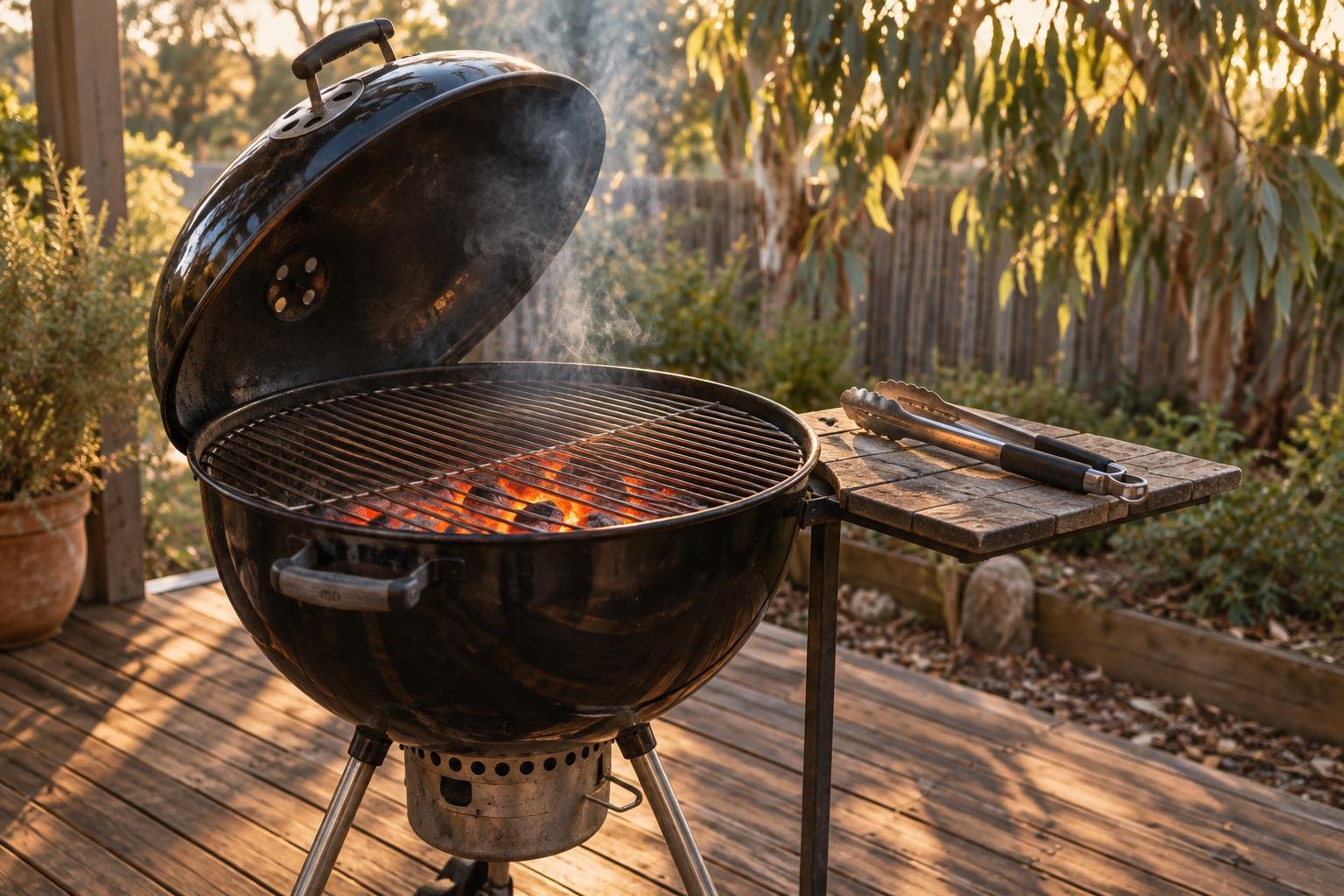
For anyone who has not shopped for a braai in Australia yet: “kettle braai” is not a brand, it is a shape, a round bowl on legs with a domed lid, first built by Weber’s founder in 1952 and copied by nearly every barbecue maker since. Weber is the original and still the most expensive name in that shape. Everything else sold as a kettle-style charcoal barbecue borrows the same idea at a lower price. If you are still working out whether “braai” and “barbecue” are even the same thing, our braai vs bbq breakdown covers that; this guide assumes you already want a kettle-shaped one and are only deciding which to buy. This comparison uses the genuine Weber Original Kettle against the kind of budget kettle braai most South African expats actually end up choosing at Bunnings, with the Jumbuck 57cm as the concrete example, since it is the budget kettle brand Bunnings stocks nationwide.
Table of Contents
- Price: the gap is real, and it is triple, not marginal
- Build quality: what “porcelain enamel” is actually covering
- Warranty: the clearest signal either maker will give you
- Heat control and cleaning up afterwards
- What is actually included in the box
- Where to buy it and what happens if something breaks
- Feature comparison
- Kettle braai vs Weber pricing, done properly
- Choose the kettle braai if you:
- Choose the Weber if you:
- Final verdict
- Frequently asked questions
Price: the gap is real, and it is triple, not marginal
The Jumbuck 57cm Black Phoenix Charcoal Kettle BBQ sells for $139 at Bunnings. The Weber Original Kettle Charcoal Barbecue 57cm sells for $399 direct from Weber, with a Premium version of the same size at $499 for those who want extras. That is close to triple the cost for the same 57cm diameter. Winner: the kettle braai, on sticker price, with no argument to be had.
Build quality: what “porcelain enamel” is actually covering
Both barbecues use a porcelain-enamelled steel body and lid, a fired glass coating fused onto the steel that resists rust and cracking under high heat. Where they part ways is the ash catcher underneath. Weber’s is aluminium, a metal that does not rust regardless of how much wet ash sits in it overnight. Jumbuck’s is powder-coated steel, which holds up fine while the coating is intact but is vulnerable the moment that coating chips, which ash, moisture and scraping tend to do over time. It is a small component carrying a real difference in how the two barbecues age.
Warranty: the clearest signal either maker will give you
Weber backs the bowl and lid for 10 years against rust-through or burn-through, the One-Touch cleaning system for 5 years, plastic components for 5 years, and every remaining part for 2 years. Jumbuck’s published terms cover the barbecue for 12 months, parts and labour, excluding surface rust and any damage from misuse. A warranty is a manufacturer betting its own money on how long the product lasts, and Weber is betting ten times longer. Winner: Weber, and it is not close.
Heat control and cleaning up afterwards
Weber’s One-Touch system sweeps ash into the aluminium catcher via a lid-mounted damper that also controls airflow without lifting the lid, and a second damper in the bowl gives fine control over cooking temperature. The Jumbuck has its own air vents for airflow control, a removable ash cup and a built-in temperature gauge, which covers the basics competently. What it does not have is a documented sweep-style cleaning mechanism, so ash removal is more likely to mean tipping and scooping than sweeping a lever. Both will hold a steady temperature once you know your vents; Weber’s system is simply better documented and, per Weber’s own product literature, more precise. Winner: Weber, though this is the closest contest of the lot.
What is actually included in the box
The Weber 57cm ships with two Char-Baskets for splitting coals either side of the grate for indirect cooking, a built-in lid thermometer, and a copy of the Complete Australian Barbecue Kettle Cookbook. The Jumbuck 57cm ships with two charcoal starter trays, chrome cooking grills, a built-in temperature gauge and bakelite handles. Both give you enough to start braaiing the day it arrives; Weber’s inclusions lean towards recipe support and indirect cooking, Jumbuck’s towards getting the fire going. Call this one a tie.
Where to buy it and what happens if something breaks
Weber sells direct through weber.com, its own Weber Store network, and Bunnings and other major retailers, backed by a documented spare parts catalogue, a barbecue registration system and a national store finder for warranty claims. Jumbuck is sold through Bunnings, which stocks replacement covers and accessories alongside it, but there is no equivalent dedicated parts and service network beyond the standard Bunnings returns process. If a part fails outside the warranty window, Weber gives you a clearer path to fixing it rather than replacing the whole barbecue.
Feature comparison
| Feature | Kettle braai (Jumbuck 57cm) | Weber Original Kettle 57cm |
|---|---|---|
| Price (verified 10 Aug 2026) | $139 | $399 (Premium version $499) |
| Diameter | 57cm | 57cm |
| Body and lid | Black porcelain enamel steel | Porcelain-enamelled steel |
| Ash catcher | Powder-coated steel | Aluminium |
| Warranty | 12 months, parts and labour | 10 years bowl and lid, 5 years cleaning system, 2 years remaining parts |
| Cooking grill | Chrome | Plated steel, hinged for coal access |
| Included extras | Two charcoal starter trays, temperature gauge | Two Char-Baskets, lid thermometer, cookbook |
| Customer rating | 3.4 out of 5 (78 ratings, Bunnings) | 4.9 out of 5 (62 ratings, Weber AU) |
| Sold at | Bunnings | weber.com, Weber stores, Bunnings and other retailers |
| Best for | Renters, first braai, tight budgets | Long-term owners, regular braaiers |
Kettle braai vs Weber pricing, done properly
Spread the Jumbuck’s $139 over even five years of use and that works out to about $28 a year, assuming nothing needs replacing. Spread the Weber’s $399 over the ten years its bowl and lid are actually warranted for, and that is about $40 a year for a barbecue with a written guarantee behind the parts most likely to fail. The real cost question is not the sticker price, it is what you do if the cheaper option needs replacing in year two or three, which is a cost the Jumbuck’s price tag does not include and the Weber’s warranty is designed to remove.
Choose the kettle braai if you:
- Are renting and might move again within a year or two
- Want to try charcoal braaiing before spending real money on it
- Are kitting out a first Australian backyard or share house on a tight budget
- Do not mind buying a replacement barbecue again in a few years
Choose the Weber if you:
- Plan to be in this house, or in Australia, for years to come
- Braai most weekends and want dependable heat control without fighting the vents
- Want a barbecue backed by a decade-long warranty on the parts that matter most
- Would rather pay the difference once than pay it twice
Final verdict
The quick verdict above is the right one for most readers, but two situations change the answer. If you are in Australia on a working holiday visa and genuinely do not know whether you will be here past its expiry, the Jumbuck is the sensible buy. It will braai a chop or a snag as well as any kettle-shaped barbecue can, and there is little to lose leaving it behind or passing it on locally when you go. If you have bought a house, or you already know you are staying, the Weber’s ten-year warranty on the bowl and lid means you are very unlikely to be buying a second kettle barbecue this decade, which makes the $260 difference shrink considerably once you divide it by the years you will actually use it. And if budget decides the matter today, there is no shame in the kettle braai. Buy it, braai properly on it, check your state’s fire rules before you light it, since a kettle’s enclosed coal bed is often treated differently under local fire bans than an open brazier, and upgrade to the Weber whenever the ash catcher finally lets you down. Whichever way this kettle braai vs Weber decision goes for you, the fire rules and the braai technique that follow are the same on either barbecue.
A kettle braai, whichever one you buy, handles direct grilling and indirect roasting well, but it is not a substitute for a potjie pot if three-legged cast iron cooking is what you are actually after; our potjie pot guide for Australia covers that separately.
Frequently asked questions
Is a kettle braai the same as a Weber?
No. “Kettle braai” describes the round, domed shape that Weber invented in 1952. A genuine Weber is one specific, branded version of that shape; a “kettle braai” bought elsewhere, such as the Jumbuck used in this comparison, is a lower-cost barbecue built to the same general design.
Which is better for a beginner, a kettle braai or a Weber?
Either will teach you charcoal braaiing perfectly well, since the vent and lid mechanics work the same way on both. The Weber’s more precise, documented airflow control makes early mistakes slightly more forgiving, but plenty of people learn on a budget kettle braai and never look back.
Do Weber kettle barbecues rust in Australia’s climate?
Weber’s own warranty covers the bowl and lid against rust-through or burn-through for 10 years, and the ash catcher is aluminium rather than coated steel, which resists rust regardless of coastal humidity or salt air. No barbecue is entirely rust-proof, but Weber’s materials and warranty are built around resisting it specifically.
Can I use a kettle braai on an apartment balcony or under a patio roof?
That depends on your state’s fire regulations and, separately, on your building’s own rules, not on which brand you buy. Check our guide to braai fire rules in Australia, state by state before you commit to either barbecue if you live in an apartment or under a covered outdoor area.
How much does a Weber kettle barbecue cost in Australia?
As of 10 August 2026, the Weber Original Kettle Charcoal Barbecue 57cm is A$399 direct from Weber, with a Premium 57cm version at A$499. Prices at other retailers may vary slightly and are worth checking before you buy.