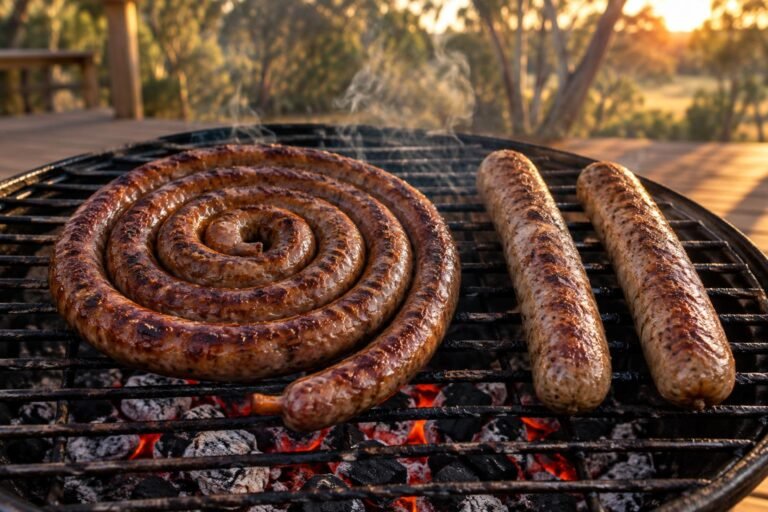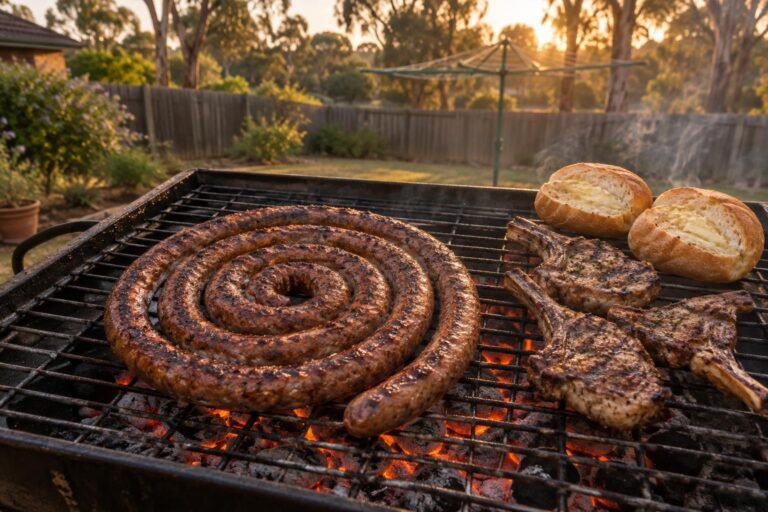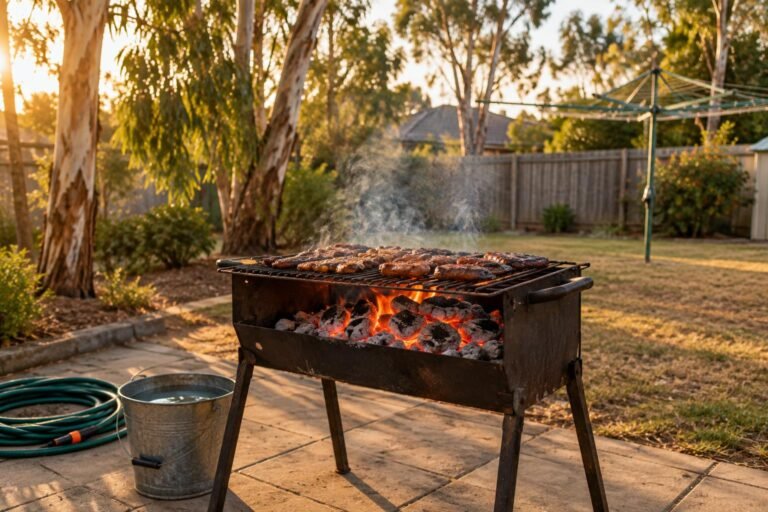
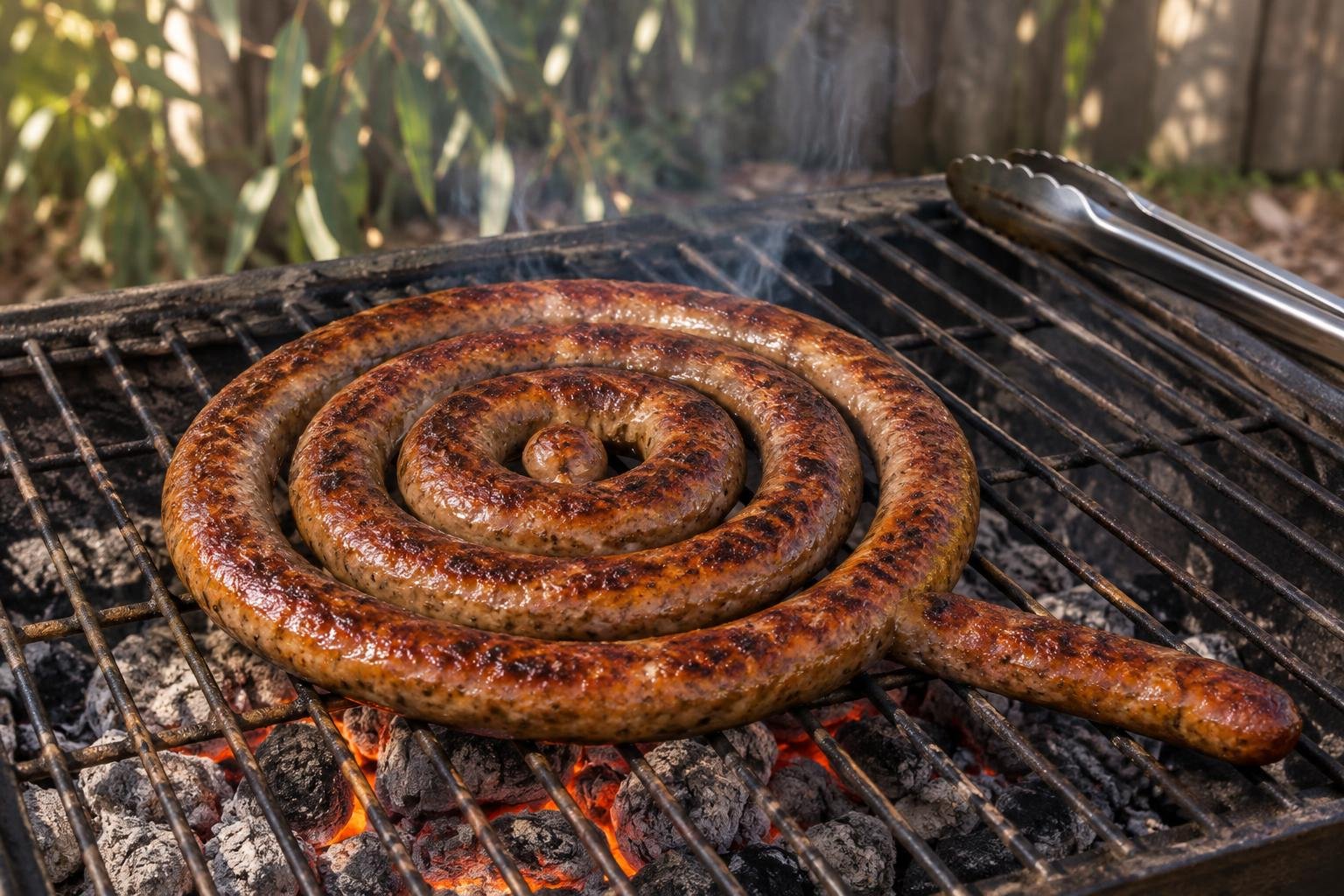
There is a particular sound that ruins a braai, and it is the hiss of a boerewors casing splitting over flames that were never ready. Learning how to braai boerewors properly is less about skill than about patience, because almost everything that goes wrong goes wrong in the first five minutes. Boerewors, for anyone reading along who did not grow up with it, is South Africa’s coarse beef sausage, heavy on coriander seed and sold as one long coil rather than in links. It is not a snag, it is not a bratwurst, and it does not want to be treated like either. Get the fire right and it rewards you. Rush it and you will be eating a dry coil while the good stuff sizzles in the coals below.
Table of Contents
Why boerewors needs different treatment
The difference starts with what is inside the casing. Under the South African regulations that define the product, boerewors must be at least 90 per cent meat, with no more than 30 per cent fat and only a small allowance for cereal or starch. That is a coarse, loosely packed, fatty sausage in a natural casing, and it behaves like one. The fat is the flavour and the fat is also the risk, because the moment it renders faster than the casing can hold it, you get a flare-up, a split, and a coil that has quietly emptied itself into the fire.
A supermarket sausage is usually finer, wetter and packed with more filler, so it tolerates abuse. Boerewors does not. That single fact drives every rule below.
Start with the coals, not the clock
The most common mistake is starting too early. Light your fire and then leave it alone. You are waiting for flames to die down completely and for the coals to settle into a steady glow under a coating of grey ash. If you can still see yellow flame licking through the grid, you are not ready, no matter how hungry anyone is.
The old hand test still works better than any gadget. Hold your palm about 12 centimetres above the grid. If you can keep it there for roughly five to six seconds before you have to move it, you are in the medium heat range that boerewors likes. Two seconds and you are far too hot; ten seconds and you are heading for a long, grey, disappointing evening.
Set your grid a little higher than you would for steak. Around 15 to 20 centimetres above the coals is a good starting point. If your braai has fixed grid heights and only one of them, spread the coals slightly thinner instead, or bank them to one side so you have a cooler corner to retreat to.
Before you light anything, check that you are allowed to. Fire restrictions in Australia change by state and by day, and a total fire ban applies to solid fuel braais even in your own backyard. Our guide to braai fire rules in Australia covers who to check with, state by state.
How to braai boerewors, step by step
Here is the whole method, and it is shorter than you might expect.
One: bring the wors to room temperature. Twenty minutes out of the fridge is plenty. Cold wors straight onto the grid cooks unevenly, so the outside is browning while the middle is still fridge cold.
Two: keep it as one coil. Do not cut it into portions before cooking. The coil holds its own shape, cooks evenly, and gives you far less exposed cut surface for juices to escape through. If your coil is enormous, use two coils rather than one giant one, so it fits the grid without hanging over the edge.
Three: never prick it. This is the one rule everybody breaks and everybody regrets. Every hole you poke is a drain. There is no steam to release and no pressure to relieve; you are simply letting the fat and juice you paid for run into the coals.
Four: use a hinged grid, or tongs. A hinged braai grid, the sort that clamps shut, is the single best piece of kit for boerewors because it lets you flip the whole coil in one movement without it stretching, sagging or breaking apart. If you do not have one, use long tongs and lift, never a fork.
Five: turn it once, maybe twice. Give it eight to ten minutes on the first side, then turn and give it a similar time on the second. Fiddling with it constantly is how casings tear. Around 20 minutes in total is a fair guide for a standard thickness coil, but the coals are the variable, not the clock.
Six: manage flare-ups by moving the meat. Never squirt water on the fire. Water throws up ash and steam and makes everything worse. If fat drips and a flame jumps, slide the coil to the cooler side of the grid for a moment and let it settle.
Knowing when it is done
This is where guesswork ends and a thermometer earns its keep. The NSW Food Authority lists 71 degrees Celsius as the safe internal temperature for minced meat and sausages, and boerewors is minced meat in a casing. Minced meat has far more exposed surface area than a steak, which is exactly why it needs to be cooked through rather than served pink in the middle.
Insert the probe into the thickest part of the coil, from the side, and take the reading away from the very centre of the spiral where the coils touch and trap heat. If you do not own a thermometer, the fallback is the old advice: cooked right through to the centre, no pink visible, juices running clear. A decent food thermometer costs less than a kilogram of good wors, which makes it the cheapest upgrade in this entire article.
Rest it before you cut it
Take the coil off the grid and let it sit for three to five minutes on a warm plate or board. This is not a fussy chef’s flourish. The juices need a moment to settle back into the meat, and a coil cut straight off the fire will bleed onto the board instead of into your mouth.
Then cut it into lengths at the table rather than in the kitchen, because half the pleasure of a boerewors coil is the moment it arrives whole and everyone works out how much they are entitled to.
Five ways people ruin good wors
- Starting on flames. If you can see fire through the grid, you are grilling, not braaiing.
- Pricking the casing. Covered above, and worth repeating, because someone always reaches for the fork.
- Turning it a dozen times. Every flip is a chance for the casing to catch and tear.
- Cutting it into pieces first. More cut ends, more escape routes, drier result.
- Cooking it from frozen. Thaw it properly in the fridge overnight. Frozen wors on hot coals gives you a burnt outside and a cold middle, every time.
What to put next to it
Boerewors is generous company. The traditional partner is a braaibroodjie, the toasted sandwich of cheese, tomato, onion and chutney cooked on the grid once the coals have calmed down. Our braaibroodjies with Australian ingredients recipe sorts out the shopping list. Pap, a stiff maize porridge, and a tomato and onion relish are the other classics, and a green salad exists mainly so that somebody can say they had a vegetable.
If you are still working out where to get proper wors in the first place, our directory of where to buy boerewors in Australia runs through the butchers, shops and online makers in every state. And if you are wondering whether any of this is really so different from firing up the Weber, our take on braai versus barbecue settles that argument, or at least restarts it politely.
Frequently asked questions
How long does boerewors take on a braai?
About 20 minutes over medium coals for a standard thickness coil, turned once or twice. Thickness and coal heat matter more than the clock, so check the temperature rather than the timer.
Should I prick boerewors before braaiing it?
No. Pricking drains the fat and juice into the coals and gives you a dry coil. The casing is meant to hold everything in.
What temperature should boerewors be cooked to?
The NSW Food Authority lists 71 degrees Celsius for minced meat and sausages. Measure in the thickest part of the coil.
Can I braai boerewors on a gas barbecue?
You can, and it will taste fine, though you lose the smoke. Use medium heat, keep the lid down for even cooking, and apply the same rules: no pricking, one or two turns, and a rest before cutting.
Do I need to oil the grid?
A light wipe of oil on the grid helps, especially with a hinged grid. Boerewors casings stick more readily than you expect, and a stuck casing tears when you flip it.
The short version
If you remember nothing else about how to braai boerewors, remember these three things: wait for ash-covered coals, never prick the casing, and turn it once. Everything else is detail. The wors does most of the work; your job is mainly to resist interfering with it.