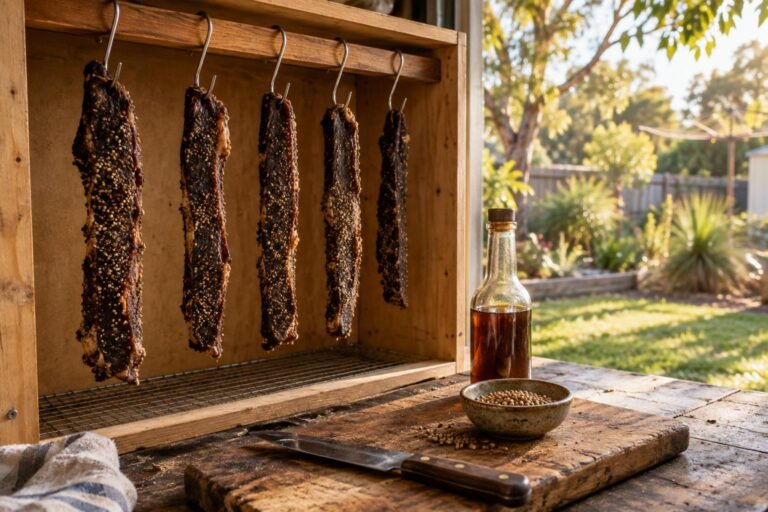
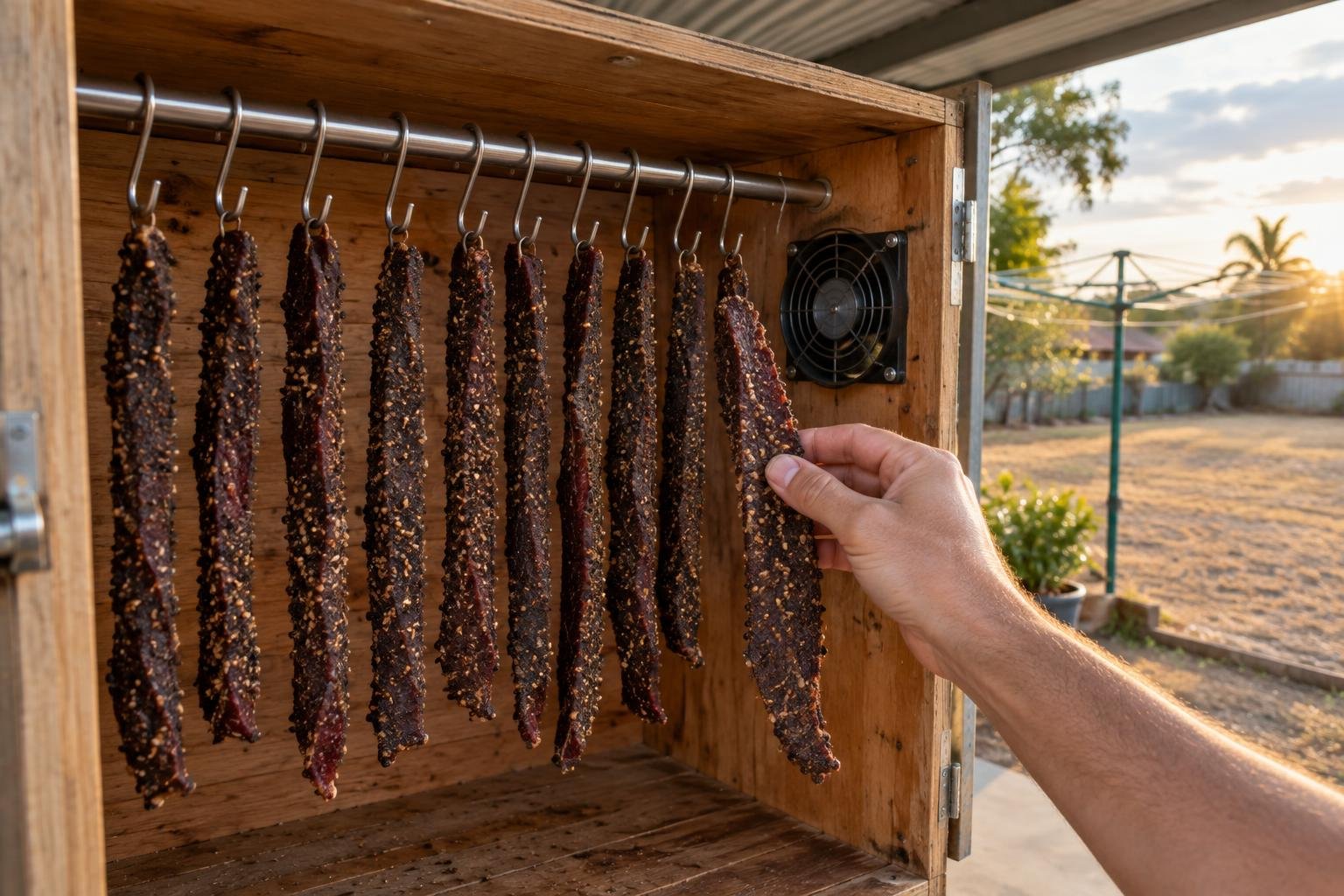
You hung a beautiful batch on Friday. By Sunday there is a soft grey bloom on the thick end of every strip and the whole lot smells faintly of a wet tent. Welcome to biltong drying humidity Queensland problems, the single most common reason South Africans give up on making biltong (air-dried, spiced strips of beef, the snack most of us grew up on) after moving to Australia. The meat is fine. Your recipe is fine. The air is the problem, and the air can be fixed.
This post covers what Queensland humidity actually does to a drying batch, the one number that matters more than humidity does, the fixes that work in a suburban Brisbane garage, when in the year to bother, and what to do when you open the box and find fur.
Table of Contents
What Queensland humidity actually does to biltong
Biltong dries because water leaves the meat faster than the air puts it back. That is the whole process. When the air around the strip is already close to full of water, the moisture in the meat has nowhere to go, so it sits on the surface. A wet surface at room temperature is a hotel room for mould, and mould checks in fast.
The Bureau of Meteorology keeps the figures for this, and they are worth looking at before you blame your recipe. At the Brisbane station in the Bureau’s climate statistics tables, the mean 3pm relative humidity across 1999 to 2010 runs at 57 per cent in January, 59 in February and 57 in March. At 9am those same months sit at 63, 66 and 66 per cent. In other words, on an average February morning in Brisbane the air is two thirds full before you have hung anything.
Compare that with July and August, where mean 3pm humidity drops to 44 and 43 per cent. That is a completely different drying environment, in the same suburb, using the same box. Nothing about your method needs to change for the batch to work. Only the calendar does.
Those numbers are Brisbane’s. If you are in Townsville, Cairns or up on the Tablelands, look up your own town on the same Bureau pages, because the further north you go the less kindly the air treats a hanging strip of beef.
The number that matters more than humidity
Here is the part most biltong advice skips. Humidity is not the target. Dryness of the finished meat is the target, and the professional measure for that is water activity, which is roughly how much free water is left in the product for bacteria and mould to use.
Australia does have a legal benchmark here. Food Standards Australia New Zealand notes in its risk statement on uncooked ready-to-eat dried meat that under the Food Standards Code, a food sold as a dried meat must be dried to a water activity of no more than 0.85. That rule is for businesses selling the stuff, not for your garage. But it tells you what “properly dry” means to people whose job is stopping food from hurting anyone.
The same document is blunt about how home batches go wrong. It lists inadequate salt and curing, and “inappropriate combinations of time, temperature and humidity applied to the drying process”, as the key risk factors in producing unsafe dried meat.
Read that list again. Time, temperature and humidity. Three dials, and in Queensland one of them is set against you by default. So you compensate with the other two, and with airflow.
Biltong drying humidity Queensland fixes that actually work
These are in order of how much difference they make.
Move more air, then move more again. This is the single biggest fix and most home boxes are badly under-fanned. A light-globe-and-a-computer-fan setup is fine in the Karoo and hopeless in a Queensland February. You want air moving briskly and constantly past every strip, carrying the moisture away rather than swirling it around. A proper bathroom extraction fan pulling air out of the top of the box, with vents low down for it to draw from, beats a small fan blowing air about inside a sealed box every time.
Dry the air, not the meat. A cheap dehumidifier in a small closed room, with the biltong box in that room, does more for a February batch than any change to your spice mix. Same story with an air conditioner: a running aircon strips water out of the air as a side effect of cooling, so a spare bedroom on a mild setting is a genuinely good biltong room. Resist the temptation to add heat instead. Warm damp air holds more water, so heating a humid room can make things worse, and warm wet meat is exactly the problem you are trying to avoid.
Cut thinner. A thick strip has to push moisture a long way to the surface, which means more days hanging, which means more hours available for something to grow. In a humid month, cut noticeably thinner than you would at home. You lose some of the chewy interior. You keep the batch.
Give every strip its own airspace. Two strips touching each other create a permanently damp contact point, and that is where the first fur always appears. Space them a good few centimetres apart, do not overload the box, and turn or re-hook them on day two so the hook end is not the only bit getting airflow.
Do not skip the vinegar. The traditional brown vinegar soak is not only about flavour. It leaves the surface of the meat acidic, and an acidic surface is a less pleasant place for mould to settle in the first hours, which are the hours that decide the batch. If you cannot get the vinegar or spices you want, our guide to South African ingredient substitutes in Australia covers the workable swaps, and the state by state directory of South African shops will tell you who stocks the real thing near you.
Be generous with the salt on a humid batch. Salt pulls water out of the meat before the air ever gets a chance to. On a February batch, a slightly longer salting stage buys you a head start you will be grateful for on day three.
When to make biltong in Queensland
Queensland has a biltong season, and almost nobody talks about it.
Using the Brisbane figures above, the good months are June through September, with July and August the standouts at mean 3pm humidity in the low forties. Cool, dry, and the mean rainfall for July and August sits around 31 and 34 millimetres for the month. That is biltong weather. It is also braai weather, which is not a coincidence; if you are still working out how the two traditions sit alongside each other, we settled that argument in braai vs bbq.
The hard months are January through March, when the mean rainfall runs 140, 176 and 149 millimetres and the mornings sit at two thirds humidity. You can absolutely make good biltong in a Brisbane summer. You just cannot make it passively. Summer batches need the dehumidifier, the strong fan and the thinner cut, all three, and they need you to check them daily rather than on Sunday.
April, May, October and November are the in-between. Watch the forecast rather than the calendar, and start a batch on the back of a dry southerly change rather than ahead of a storm week.
What to do when you find mould
First, look at it properly, in good light.
A thin white or pale grey bloom, dry to the touch, that wipes off with a cloth dipped in vinegar and leaves clean meat behind, is usually a surface issue. Wipe it, get the strip back into much stronger airflow, and watch it closely for the next day. Plenty of experienced makers save a batch at this stage.
Anything fuzzy, anything green, black or blue, anything slimy, and anything that smells sour, ammonia-like or simply wrong, goes in the bin. All of it, not just the affected strip. This is not the moment to be thrifty. You are dealing with an uncooked meat product and there is no cooking step later to bail you out.
Then fix the cause before the next batch, because mould is a symptom. Nine times out of ten in Queensland the cause is airflow, not hygiene. If the surface of your strips is still shiny or tacky after the first twenty four hours, the air is not doing its job and the batch was in trouble before the mould arrived.
Frequently asked questions
Q: What humidity is too high for biltong drying in Queensland?
A: There is no single legal cut-off for a home batch, but as a working rule, once the air in your drying space is sitting above about 60 per cent you need active help: a dehumidifier, an aircon, or much stronger extraction. Below roughly 50 per cent a well-built box will usually manage on its own.
Q: Does biltong drying humidity Queensland weather make a heated box a bad idea?
A: Heat on its own is not the answer here. Adding warmth to already damp air raises the temperature of the meat without giving the moisture anywhere to go, which is the worst of both worlds. Prioritise extraction and dehumidification first, and treat gentle warmth as a finishing touch, not the engine.
Q: Can I dry biltong in the fridge?
A: You can, and in a Queensland summer some people do, because a fridge is a cold, relatively dry, moving-air box. It is slow and it will scent everything else in there, so use a spare fridge if you have one. It is a workaround, not a replacement for a proper box.
Q: How do I know when it is actually done?
A: Squeeze it. A finished strip should feel firm right through with no soft, springy core, and a cut face should look evenly dark rather than wet and red in the middle. If in doubt in a humid month, give it another day. Under-dried biltong in Queensland does not keep.
Q: Why did my batch work in July and fail in February?
A: Almost certainly nothing you did. The mean 3pm humidity in Brisbane is around 43 per cent in August and around 59 per cent in February, so the same box is doing a completely different job in each month. February needs the extra kit; July does not.
The short version
Queensland does not stop you making biltong. It just stops you making it lazily. Move much more air than you think you need, dry the air rather than heat it, cut thinner in the wet months, and hang your big ambitious batches between June and September when the weather is doing half the work for you.
Before your next batch, do one thing: look up your own town on the Bureau of Meteorology climate tables and write the 9am and 3pm humidity figures for this month on the side of your box. Once you can see the number you are fighting, every other decision gets easier.