Every South African family has a boerewors recipe, and every one of them is the correct one. Ask two expats in the same Melbourne backyard and you will get two different answers and a lasting silence. What nobody argues about is the problem: the ready-made spice mixes from home are hard to find in Australia, and the supermarket sausage aisle is no help at all. This boerewors spice mix recipe fixes that with a scale and the ordinary spice aisle at Coles or Woolworths. Below you will find the mix in grams per kilogram of meat, how to toast and grind it properly, and what to do with it whether or not you own a sausage stuffer. No secret family measurements were harmed in the making.
Table of Contents
What actually goes into boerewors
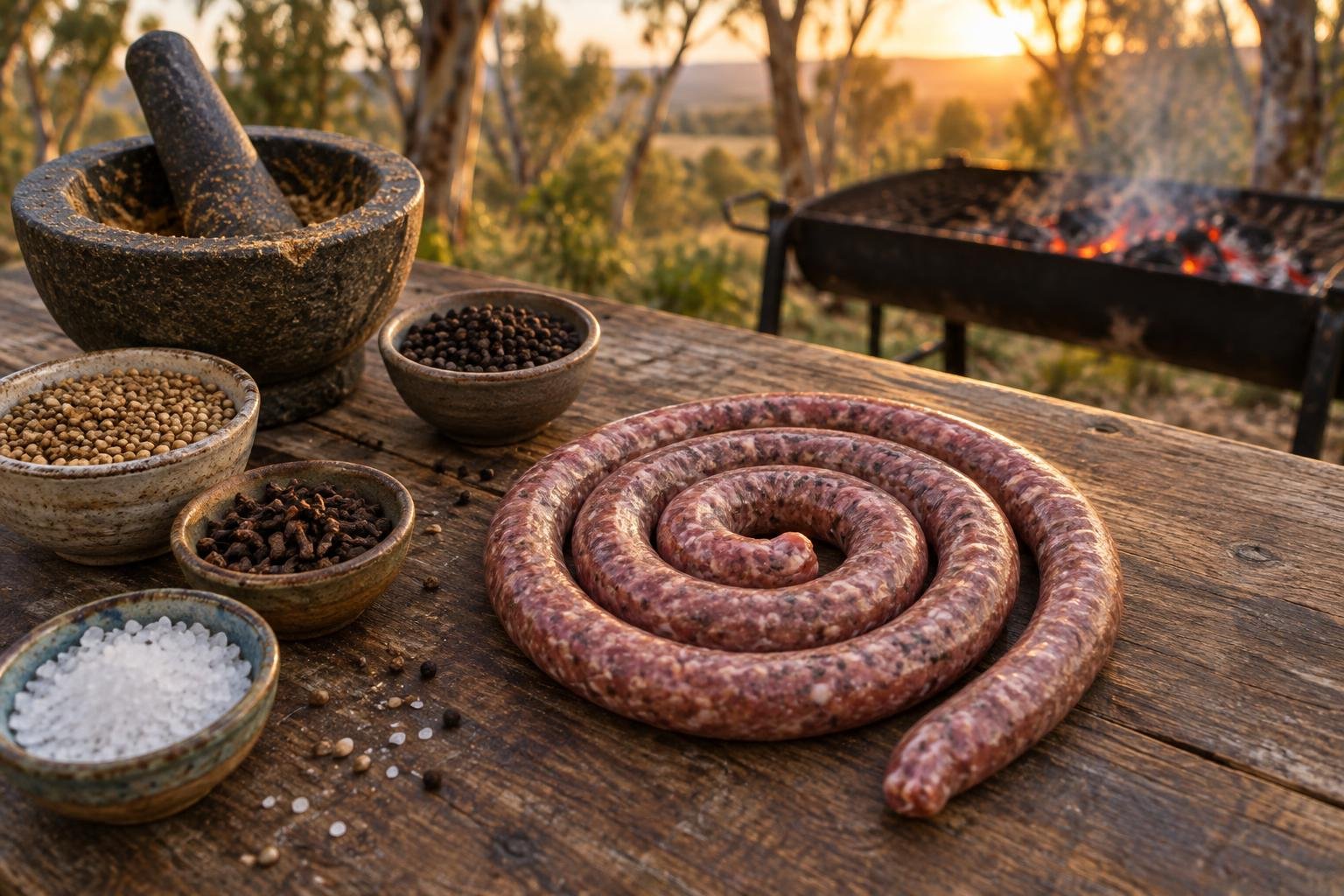
Boerewors, for the Australians reading along, is South Africa’s farmer’s sausage: a thick, coarse beef sausage seasoned with coriander and vinegar, sold coiled like a rope and cooked over a fire. It is serious enough business back home that the South African government legally defines it. Under the official regulations published under the Agricultural Product Standards Act, anything sold as raw boerewors must contain at least 90 per cent meat, carry no more than 30 per cent fat, and contain no mechanically recovered meat or colourants. The only extras allowed are things like vinegar, spices, salt and a little cereal or starch.
That legal list is also a handy summary of the flavour. Boerewors tastes of good meat, toasted coriander, black pepper, a whisper of clove, and brown vinegar. That is the whole orchestra. The spice mix below covers everything except the meat and the vinegar, which come later.
One honest note before the grams. There is no single authentic ratio; family recipes vary from valley to valley and always have. What follows is the Braaimate house mix, sitting comfortably in the middle of tradition, with notes on where to push it.
The gram-for-gram boerewors spice mix recipe
Everything here comes from a normal Australian supermarket spice rack. Quantities are for 1 kg of meat, with a scaling table below.
| Ingredient | Per 1 kg meat | Notes |
|---|---|---|
| Whole coriander seeds | 10 g | The signature. Toast before grinding, always |
| Black peppercorns | 2 g | Grind with the coriander |
| Whole cloves | 1 g | About 8 to 10 cloves. The line between wors and potpourri is thin; do not exceed this |
| Ground nutmeg | 1 g | Optional but traditional in many families |
| Ground allspice | 1 g | Some families swear by it, some have never heard of it. Try it once |
| Fine salt | 12 g | Roughly two teaspoons |
That gives you about 27 g of mix per kilogram. When you make the wors itself you will add brown vinegar, about 30 to 40 ml per kilogram, but keep that separate: the dry mix stores, vinegar does not.
Scaling up for a proper batch:
| Batch | Coriander | Peppercorns | Cloves | Nutmeg | Allspice | Salt |
|---|---|---|---|---|---|---|
| 2 kg | 20 g | 4 g | 2 g | 2 g | 2 g | 24 g |
| 5 kg | 50 g | 10 g | 5 g | 5 g | 5 g | 60 g |
A cheap kitchen scale that reads single grams costs less than a takeaway coffee habit and is the difference between a recipe and a guess. If you want to lean more traditional, push the coriander up towards 15 g per kilogram and drop the allspice. If you are cooking for spice-shy Australian in-laws, halve the cloves, not the coriander.
Toasting and grinding: the ten minutes that matter
The single biggest upgrade you can make is refusing to use pre-ground coriander from a jar. Whole seeds, toasted, then ground, taste like a different spice entirely.
Here is the routine. Tip the coriander seeds into a dry pan over medium heat. Shake the pan gently for two to three minutes until the seeds smell nutty and a few of them turn a shade darker. Do not walk away; the gap between toasted and burnt is about the length of one text message. Tip them onto a plate to stop the cooking.
Once cool, grind the coriander, peppercorns and cloves together. A mortar and pestle gives the traditional slightly coarse grind, where you still meet the odd fleck of coriander husk in the finished wors, and that is a feature. A cheap coffee grinder kept for spices works too; pulse it, do not run it, or you will make powder. Sieve out any large husks if you like, then stir in the nutmeg, allspice and salt.
Stored in an airtight jar away from sunlight, the mix keeps its punch for about a month. It stays safe far longer, but toasted coriander fades, so make batches you will actually use.
Turning the mix into wors in an Australian kitchen
The good news is that Australian butchers are well set up for this. The classic base is beef chuck or brisket with a share of pork for fat and softness, coarsely minced. Many butchers will mince to order if you ask nicely and avoid the lunchtime rush; ask for a coarse plate, since fine supermarket mince makes wors with the texture of a frankfurt.
For the record, an ordinary Australian sausage only has to be half meat: under Standard 2.2.1 of the Australia New Zealand Food Standards Code, anything sold as a sausage must contain no less than 500 g/kg of fat-free meat flesh. Your homemade wors, at 100 per cent meat you chose yourself, is playing a different sport. Aim for meat that is roughly 20 to 30 per cent fat overall. Too lean is the most common homemade mistake; fat is where the flavour and the juiciness live.
Mix the spice through the mince with the vinegar, working it gently and briefly with cold hands. Overworking smears the fat and toughens the wors. Then rest the seasoned mince in the fridge overnight so the coriander and vinegar get to know the meat.
Casings are the one item the supermarket will not solve. Butchers often sell natural casings if you ask, and the South African shops around the country stock them along with ready-made mixes when you would rather not blend your own; our state-by-state directory of South African shops lists the ones worth knowing. Stuff loosely, wind the whole length into one flat coil in the traditional style, and you have wors ready for the fire. Cook it over medium coals, turning once, and never prick it. If you are still fuzzy on why this happens over a fire and not under a grill, our piece on braai vs bbq settles that old argument.
No sausage stuffer? Three other uses for the mix
The mix earns its place in the pantry even if you never case a sausage.
First, wors patties. Season coarse beef and pork mince exactly as above, rest it overnight, then shape flat patties and braai them. All the flavour, none of the equipment, and they sit happily on a braaibroodjie roll.
Second, everyday mince. A teaspoon of the mix lifts bolognese, meatballs or cottage pie in a direction Australian dinner guests will notice but cannot place. Watching someone try to identify toasted coriander in a meatball is quiet, honest entertainment.
Third, basting and rubs. Mixed with a little oil and an extra splash of brown vinegar, it makes a rub for chops or chicken flatties that carries the same fireside signature.
And if the rest of your pantry is missing its South African staples too, the boerewors mix is just one entry in our complete guide to South African ingredient substitutes in Australia, which handles everything from Mrs Balls to maizena.
Frequently asked questions
Q: Can I buy ready-made boerewors spice mix in Australia?
A: Yes, South African grocery shops in most capital cities stock imported mixes, and some butchers with South African owners blend their own. The trade-off is price and freshness, since toasted coriander fades in a packet that crossed an ocean. The homemade mix costs a fraction as much and you control the clove.
Q: What is the right ratio of coriander to cloves in a boerewors spice mix recipe?
A: The house mix runs roughly ten parts coriander to one part cloves by weight, and that is a sensible ceiling for the cloves. Coriander should lead clearly, with clove as a background warmth you notice only when it is missing. If you can name the clove flavour while eating, there is too much of it.
Q: Does boerewors have to contain pork?
A: No. The South African regulations allow beef, pork, lamb or goat in any combination, and plenty of families make all-beef wors. Pork is popular because its fat keeps the sausage juicy, but a fattier cut of beef does the same job if pork is off the menu.
Q: How long does the dry mix keep?
A: In an airtight jar in a dark cupboard it is at its best for about a month, and still perfectly usable after that, just quieter. The salt keeps it safe more or less indefinitely; it is the aroma of the toasted coriander that fades. Small fresh batches beat one heroic jar.
Q: Can I use ground coriander from the jar instead of whole seeds?
A: You can, and the wors police will not attend, but the result is noticeably flatter. Pre-ground coriander skips the toasting that creates the nutty depth boerewors is known for. If you make one effort in this whole recipe, make it the toasted whole seeds.
Make a jar this weekend
The whole job, from spice aisle to sealed jar, takes about fifteen minutes, and it puts the taste of home within reach of any Australian kitchen with a frying pan. Weigh it, toast it, grind it, and keep the jar where you can see it. Then, when you are ready for the full ceremony of casings and coils, the mix will be waiting. Start with the pantry basics sorted: read our complete South African ingredient substitutes guide and get the rest of the cupboard speaking Afrikaans too.