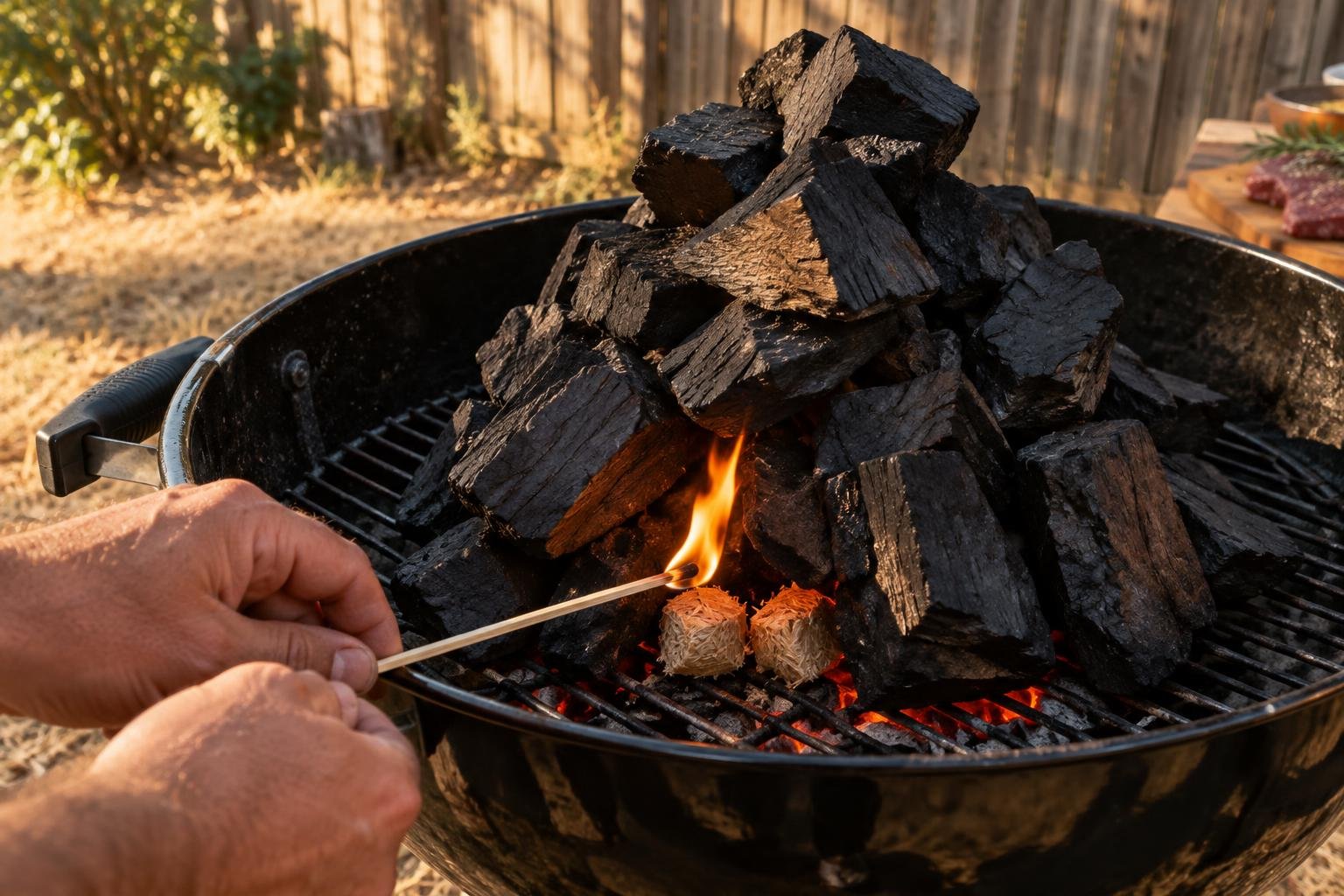
The short version of how to light a braai fire is this. Two firelighters on the fuel grate, a tight pyramid of charcoal over them, every vent open, lid off, then leave it alone for twenty to thirty minutes. No poking, no fanning, no flapping a bread board at it. The fire does its job while you get the meat out of the fridge.
The chemical taste is a separate problem, and almost never the firelighter’s fault. It is a timing fault. Those white blocks are designed to burn away completely, and they do, but only if you give them time. Put the grid on while a flame is still licking up between the coals and you are cooking in the fumes. Wait for grey ash and the taste goes with it.
Table of Contents
Why a braai ends up tasting of firelighters
Three causes, and only one of them is about what you bought.
You started too early. Nearly always it. The coals glow, the wors goes on, and the last of the firelighter is still gassing off underneath. Fat drips into it, and that smell ends up in the meat.
You used a petroleum block. The cheap white cubes at the servo are kerosene based, and they take longer to burn off than the natural ones. Firelighters made from compressed wood fibre and wax cost a little more and leave nothing behind.
You used lighter fluid. Do not. It flares, it is easy to misjudge, and it puts a petrol edge on food that no marinade will hide.
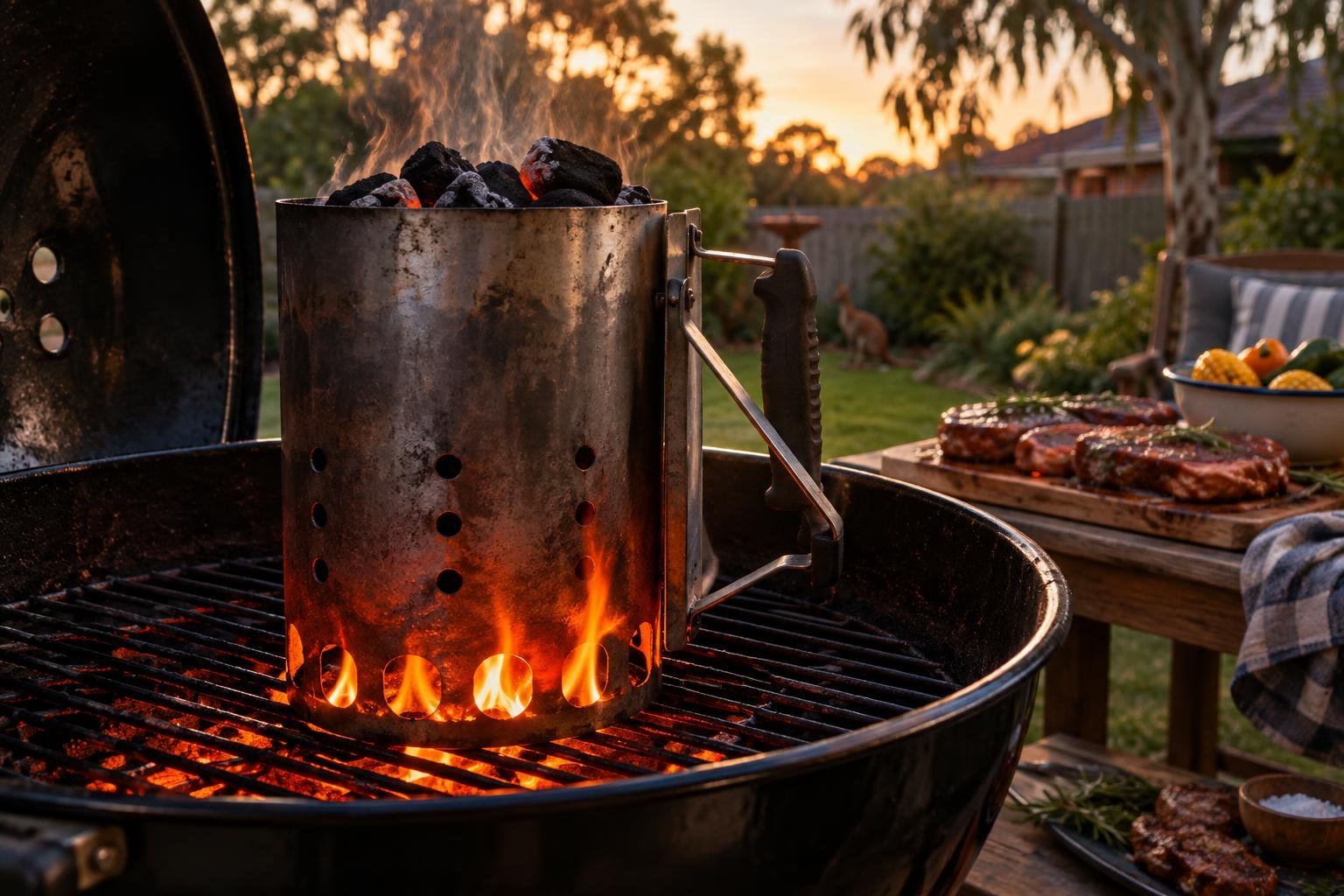
How to light a braai fire, step by step
This is the pyramid method. It works in a kettle, an open grid braai or a drum, it is the one your father used, and it is still the most reliable.
- Clean out the ash first. Old ash blocks the bottom vents, and a fire with no air underneath will sulk for half an hour and then die. Scrape it out and open every vent.
- Put two firelighters on the fuel grate, a hand’s width apart, near the middle.
- Build a pyramid over them. Small pieces leaning together like a tent, bigger pieces on the outside. Leave gaps. Charcoal packed tight will not catch.
- Light them with a long match and step back. Lid stays off.
- Leave it for twenty to thirty minutes. The flames climb, peak, then drop away on their own. That drop is the part people mistake for the fire dying. It is the fire getting ready.
- Spread the coals when they are grey, put the grid on, and let it heat through for five minutes before anything touches it.
How much fuel? A pile about the size of a rugby ball for two people and a coil of wors. Double it for a family Sunday, and bank half of it to one side so you have a cooler zone to move things to.
The chimney starter does the same job in half the time
A chimney starter is a steel tube with a grate part way up. Fuel goes in the top, firelighters underneath, and the tube funnels heat straight up through the charcoal instead of letting it wander off sideways. It fixes the taste problem on its own, because the firelighters sit in a separate chamber and are long gone by the time the coals go in the braai.
Heat Beads is an Australian brand and knows its own product. Fill the chimney to the rim, light three firelighter cubes, stand the chimney over them, and expect a full chimney of briquettes to reach its best temperature in about thirty to forty minutes. Read the full Heat Beads chimney instructions for the rest. Two details matter: the briquettes are ready when they are covered in light coloured ash and not before, and you tip them out as soon as they ash over, because leaving them in shortens the chimney’s life.
Weber’s own Rapidfire chimney starter holds about 2.5 kg of briquettes in a six litre body, which is plenty for a 57 cm kettle. Wear a glove. The handle stays cool, the rest does not.
Some links below are affiliate links. Same price for you, a small commission for the braai fund. As an Amazon Associate, Braai Mate earns from qualifying purchases.
Weber Rapidfire Chimney Starter. Big enough for a family braai, sturdy enough to last years, and it will pay for itself in firelighters you no longer have to use three at a time. Check the price at Amazon
Affiliate link. Same price for you, a small commission for the braai fund.
Australian fuel, and what it changes
Back home you bought a bag of Namibian hardwood and never thought about it again. Here the shelf looks different, and the three options change how to light a braai fire and how long it takes. The timings below are what we get in a 57 cm kettle in Brisbane, not laboratory figures.
| Fuel | Ready to cook | How long the heat holds | Best for |
|---|---|---|---|
| Australian hardwood lump charcoal | About 20 to 25 minutes | Roughly an hour of good heat | Wors, chops, steak, anything hot and quick |
| Heat beads and other briquettes | 30 to 40 minutes in a full chimney | Ninety minutes or more, very steady | A potjie, a big crowd, a long cook |
| Hardwood firewood, red gum or ironbark | 45 minutes to an hour | As long as you keep feeding it | The traditional braai, and the smell |
If you are still deciding what to keep in the shed, we have gone through charcoal versus briquettes for an Australian braai in detail, and the best wood for a braai in Australia covers which local species behave like the ones you grew up with.
How to tell the coals are actually ready
Three checks, and all three have to pass.
No flame. Not a small one, not a flicker at the edge. Glowing red with no flame is what you want.
Grey all over. The coals should be dressed in pale ash. A black patch is a cold patch, and it will still be cold in twenty minutes.
The hand test. Hold your palm about a hand’s width above the grid and count. Two or three seconds before you have to move it is searing heat, good for steak and lamb chops. Five or six seconds is the medium heat most things want, wors included. Longer than that and you are better off waiting. Rough, unscientific, and it has never once let anybody down.
If the middle runs hotter than the edges, that is normal in a kettle. Rake a two thirds to one third split, hot side and cool side, and you have somewhere to move things that are browning too fast. That same split is what makes a potjie on a braai workable.
What to do on a total fire ban day
This catches new arrivals out, because South Africa has nothing like it. On a declared total fire ban day the NSW Rural Fire Service is blunt: a barbecue burning solid fuel, meaning wood, charcoal or heat beads, cannot be used outdoors at all. Gas and electric are allowed under conditions, including an adult present, nothing burnable within two metres, and water on hand. The NSW RFS total fire ban rules put the on the spot fine at $2,200, which is an expensive way to learn.
Every state words it differently, and the day you most want to braai is often the day a ban is declared. We have set out the braai fire rules state by state so you can check yours on the morning, before you buy the meat.
Frequently asked questions
How long does it take to light a braai fire?
Twenty to thirty minutes with a pyramid of lump charcoal, and the same or a little longer with briquettes. A chimney starter cuts the fuss rather than the clock and gets you a more even bed of coals. If your fire is ready in ten minutes, it is not ready, it is just on fire.
Can I light a braai fire without firelighters?
Yes. Scrunched newspaper under dry kindling works, and so does a cardboard egg carton with a little cooking oil in each cup. Both need more kindling than you think. A chimney starter makes either far more likely to work.
Should I put the lid on while the fire is lighting?
No. The lid on a kettle is a heat control for cooking, not a lighting aid. Closing it early starves the fire of air and you will be back out there with a match. Lid off until the coals are grey and spread.
Why does my braai food taste like chemicals?
Almost always because the grid went on too early and the firelighters were still burning off. Give it another ten minutes and cook on grey coals. If it keeps happening, move from petroleum cubes to natural wood and wax firelighters, or buy a chimney starter and keep the firelighters out of the braai entirely.
Should I use lighter fluid on a braai?
No. It flares without warning and leaves a petrol taste that survives any amount of marinade.
Get the fire right and the rest of the braai forgives you a lot. Knowing how to light a braai fire properly comes down to one habit: light it, set a timer for twenty five minutes, and do not touch it until the timer goes. If you are still fighting your braai after that, the problem is airflow rather than technique, and the kettle braai versus Weber comparison explains which vents matter and why.